

 عربى
عربىCar bumper molds are classified by injection method, parting line arrangement, and number of cavities. The following bullet points describe the main types used in automotive manufacturing.
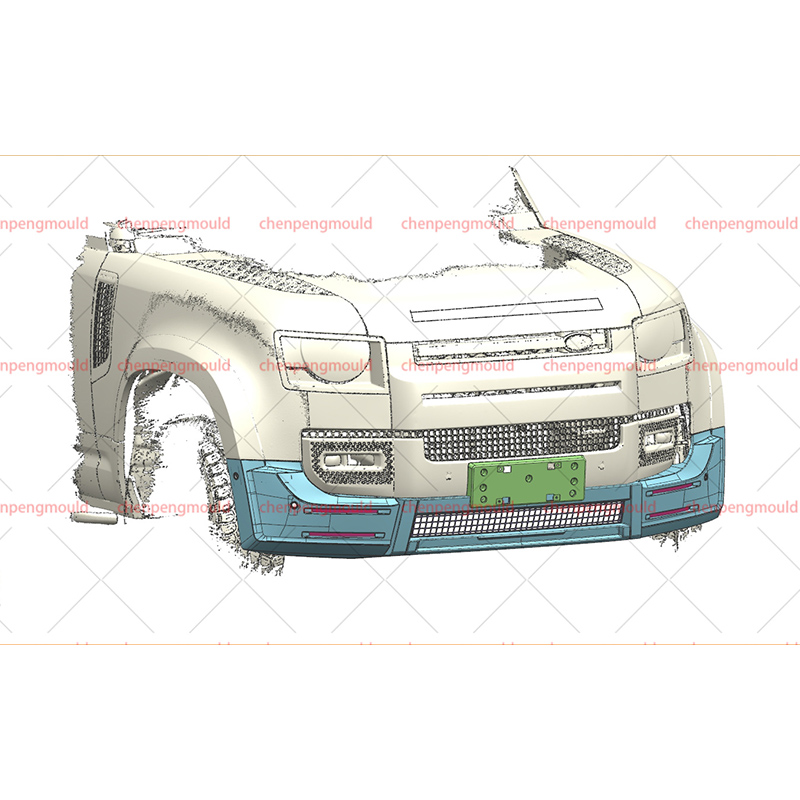
Two-Plate Cold Runner Mold: The simplest construction with a single parting plane. Melted plastic enters through a sprue, flows into runners, then through gates into the cavity. After ejection, the runner system separates from the part. This type accounts for approximately 60 percent of bumper molds for vehicles with annual production under 30,000 units. Mold base size ranges from 1,200 mm × 1,000 mm to 2,000 mm × 1,500 mm.
Three-Plate Cold Runner Mold: Two parting planes allow the runner system to be stripped automatically from the part. The sprue is pulled from the fixed plate while the runner detaches at the second parting line. This type is specified for fully automated production cells where manual runner removal is not possible. Cycle time is 3 to 5 seconds longer than two-plate molds due to additional plate movement.
Hot Runner Mold: The runner system is kept molten using heated manifolds and nozzle tips. No runner solidifies, reducing material waste by 15 to 25 percent compared to cold runner systems. Hot runner molds for bumpers typically contain 4 to 8 valve gate nozzles arranged along the cavity length. Initial cost is 30 to 50 percent higher than cold runner molds, but the payback period is 12 to 18 months for high-volume production exceeding 100,000 parts per year.
Low-Pressure Injection Mold: Designed for injection pressures below 30 MPa (compared to 80-120 MPa for conventional molds). Cavities are machined from aluminum alloy rather than steel. Venting channel depth is 0.08 to 0.12 mm. These molds are used for prototype batches (100 to 500 parts) or for thermoplastic olefin (TPO) materials requiring gentle filling. Mold life is 10,000 to 50,000 cycles, compared to 500,000+ cycles for steel molds.
The following numbered list details the materials selected for different components of car bumper molds, based on service conditions and production volume.
Cavity and Core Steel (High Volume >500,000 parts): DIN 1.2343 (X40CrMoV5-1) or AISI H11 chromium hot-work steel. Composition: 0.38% carbon, 5.0% chromium, 1.3% molybdenum, 0.4% vanadium. Hardness after quenching and tempering is 48-52 HRC. This steel maintains dimensional stability at mold temperatures up to 80°C. Tensile strength is 1,450 MPa. Thermal conductivity is 24 W/m·K at 20°C. For bumper molds with complex cooling channels, 1.2343 is preferred over P20 due to better polishability (Ra 0.05 microns achievable).
Precautions for Using the Car Bumper Mold
The following precautions are indicated by special symbols to highlight safety, quality control, and maintenance requirements specific to bumper molds.
Clamping Force Verification: The required clamping force for a bumper mold is calculated as 0.3 to 0.5 tons per square centimeter of projected area. For a typical sedan bumper (projected area 2,500 cm²), the required force is 750 to 1,250 tons. Operating below this force causes mold separation at the parting line, producing flash of 0.2 to 0.5 mm thickness. Operating at more than 1.5 times the required force deforms the mold base plates, creating permanent deflection visible as a 0.03-0.05 mm gap when measured with a feeler gauge. Check clamping force using strain gauges mounted on the tie bars, not by reading the machine's pressure gauge alone.
Mold Temperature Control Profile: Bumper molds require three independent temperature zones: gate area (50-60°C for PP, 60-70°C for TPO), central cavity (40-50°C), and end-of-fill zones (30-40°C). Temperature differences exceeding 15°C between the gate and end zones produce differential shrinkage, resulting in a warped bumper with a twist of 3-5 mm per meter length. Monitor each zone using thermocouples inserted to within 5 mm of the cavity surface. Circulate temperature-controlled water (not tap water) at flow rates of 15-25 L/min per cooling circuit.
Injection Speed and Pressure Limits: For a 2,000 mm long bumper with nominal thickness 2.5-3.5 mm, the injection speed should be set to 80-120 mm/s at the screw. Higher speeds (above 150 mm/s) cause jetting and air entrapment visible as silver streaks on the Class A surface. Lower speeds (below 60 mm/s) produce a wavy appearance called "flow mark." Maximum injection pressure at the nozzle should not exceed 120 MPa for PP and 140 MPa for TPO. Pressures above 160 MPa cause cavity deflection, increasing the part thickness by 0.1-0.2 mm at the center zone.
Drying of Hydroscopic Materials: Bumper materials such as PA6 (polyamide) or ABS require drying before processing. PA6 must be dried to below 0.15% moisture content using a desiccant dryer at 80°C for 4-6 hours. Processing wet PA6 produces hydrolyzed gas that condenses on the cooled mold surface, forming white deposits in the cavity. These deposits prevent proper release and require mold disassembly for cleaning. PP and TPO do not require drying but should be stored in sealed containers to avoid dust contamination.
Ejector System Timing: Bumper molds typically use 8 to 16 ejector pins, plus air poppets or hydraulic ejector plates. Ejector stroke should be 5-10 mm less than the full cavity depth to avoid marking the part. Set ejector advance speed to 20-30 mm/s; higher speeds (above 50 mm/s) cause the bumper to separate abruptly, leaving witness marks at the ejector pin locations. For deep-draw bumper designs (cavity depth exceeding 80 mm), use a two-stage ejection: first 40 mm at 15 mm/s, then full stroke at 25 mm/s.
Venting Depth and Cleaning Frequency: Venting lands on the parting line should be 0.03-0.05 mm deep and 6-10 mm wide for unfilled PP and TPO. For glass-filled materials (10-30% GF), vent depth increases to 0.06-0.08 mm to allow glass fibers to escape. Vents clog after 10,000-15,000 cycles due to degraded polymer residue. Clean vents using ultrasonic cleaning at 40°C with a mild alkaline detergent for 20 minutes, followed by compressed air drying. Never use metal picks or wire brushes on vent depths, as they enlarge the vent and cause flash.
 +86-18357617666